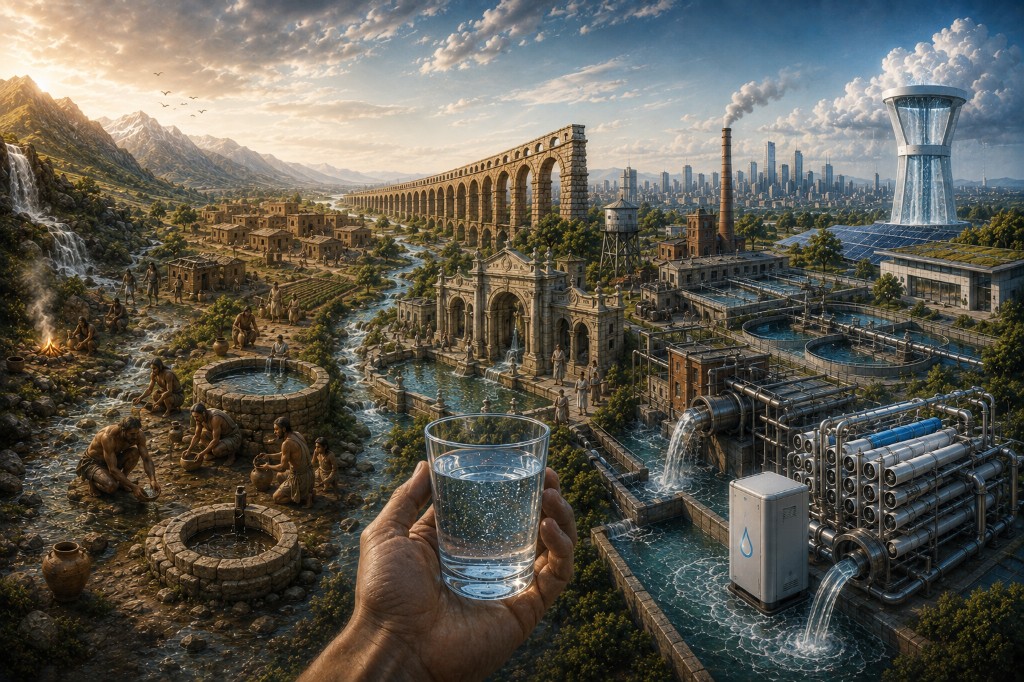
From the first springs and wells to aqueducts, cholera, chlorination, reverse osmosis and atmospheric water generators – the history of drinking water is in fact the history of human civilization.
Water is such a natural part of daily life that we rarely stop to think how unusual an achievement a glass of safe drinking water really is.
We turn a tap. We open a bottle. We press a button on a dispenser.
But behind this apparently elementary act stand millennia of observation, engineering, epidemics, scientific discoveries and technological revolutions.
Humanity understood very early that it cannot exist without water. It took thousands of years, however, to understand something far more complex: the presence of water and the presence of safe drinking water are two completely different things.
It is precisely this distinction that changes history.
Today we already know how to purify river water, desalinate seawater, recycle wastewater and even extract water from the air.
To understand the significance of these technologies, we need to trace how one of humanity’s oldest questions has changed:
Where will we get water?
Water before civilization
The need for water is not a human discovery. Thirst is a biological mechanism that arose long before Homo sapiens appeared.
That is why early humans did not need knowledge of dehydration, electrolytes or kidney function in order to look for water. The body itself signals the need.
The harder question was where to find it.
For early human communities, the geography of water largely determined the geography of life. Rivers, lakes, springs and seasonal pools were at once a source of drinking water, a landmark for migration and a place around which life concentrated.
Watching animals, vegetation and the terrain was probably part of the practical knowledge of finding water. Generations remembered the location of springs, the seasonal movement of rivers and the places where groundwater came close to the surface.
This knowledge was not theory.
It was a condition of survival.
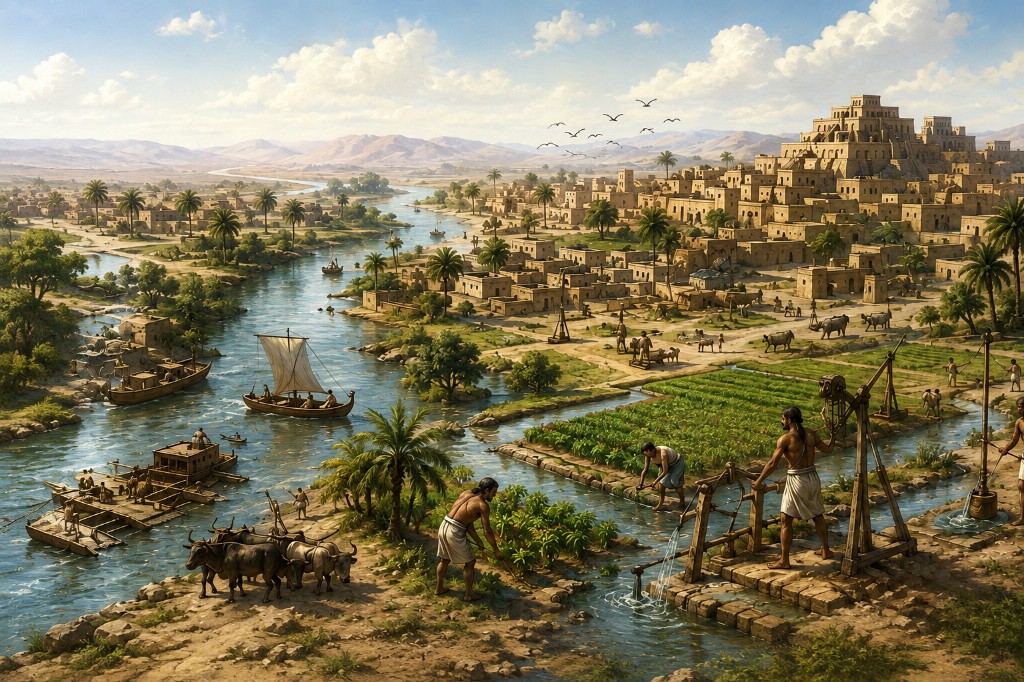
When water begins to create civilizations
The appearance of permanent settlements changes the relationship between people and water.
A hunter-gatherer can move towards the water source. An agricultural community has to secure water where it lives.
So water gradually turns from a natural given into a resource that has to be managed.
It is no accident that some of the most significant ancient civilizations arose around large river systems.
Egypt developed around the Nile.
Mesopotamia – between the Tigris and the Euphrates.
The cities of the Indus civilization – along a vast water system in South Asia.
The early Chinese civilizational centres – around the Yellow River and other great rivers.
The reason is not only the need for drinking water.
Water makes irrigation, food production, animal husbandry, transport and trade possible.
In a sense, the first great states were also the first great systems for managing water.
The first forms of water purification
Long before microbiology appeared, people noticed that the quality of different water sources was not the same.
Spring water can taste different from river water. Stagnant water can smell. Cloudy water can be left until the solid particles settle.
That is how early methods of water purification arose.
Among them are settling, straining through various materials and heating.
These methods were not based on knowledge of bacteria or viruses. They were the result of observation.
This is where a pattern appears that repeats many times in the history of water:
humanity discovers what works long before it understands why it works.
Boiling is an excellent example.
Heating water can destroy many disease-causing microorganisms, even though the people who used this approach in antiquity could not have known they existed.
Modern science confirms the effectiveness of boiling against bacteria, viruses and parasites, but it does not automatically make chemically contaminated water safe.
The well: one of the most important technologies in the history of water
The well looks simple, but the consequences of its appearance are enormous.
Instead of depending only on surface water, a human community gains access to groundwater.
That makes it possible for settlements to develop in places that would otherwise have been hard to inhabit.
In ancient cities there appear not only wells, but also cisterns, canals, reservoirs and drainage systems.
Especially impressive are the urban structures of the Indus civilization, where as early as the 3rd millennium BCE there were numerous wells and sophisticated systems for carrying water away.
Gradually a concept arises that we now take as obvious:
clean water must be kept separate from wastewater.
This turns out to be one of the most important conditions for public health.
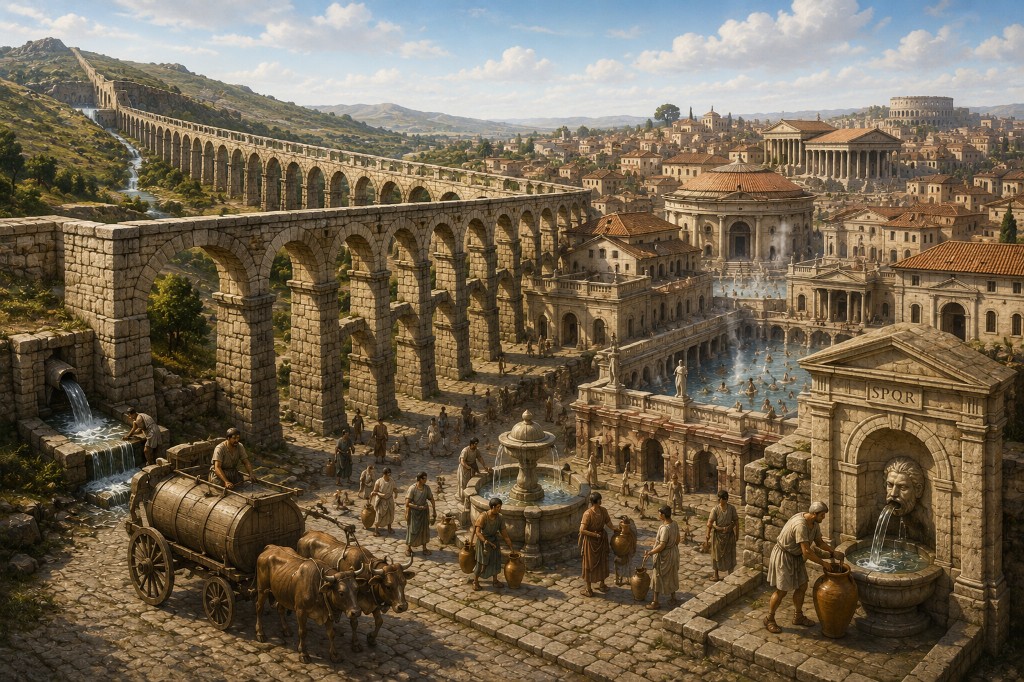
The Roman revolution: when water begins to come to people
Roman aqueducts are among the most recognizable symbols of ancient engineering.
Their true significance, however, is not architectural.
It is logistical.
People no longer had to settle immediately on top of the water source. Water could be transported over long distances through carefully designed systems that used gravity above all.
Roman water-supply infrastructure served public fountains, baths and various urban facilities.
Here a concept appears that remains fundamental to modern water supply:
water has a source, a system of transport and an end point of consumption.
The modern water network is incomparably more complex technologically, but the logic is the same.
The great paradox of cities
There is a problem, however.
The more successful a city is, the more people it concentrates in a small area.
And more people mean more waste.
For centuries cities grew much faster than their sanitary infrastructure. Cesspits, animal waste, contaminated soils and water sources often existed in dangerous proximity.
This created one of the most serious problems in the history of drinking water:
faecal contamination.
It is through this that dangerous microorganisms can enter the water.
The most treacherous part is that such water is not necessarily cloudy or unpleasant.
It can look perfectly clean.
Here the human senses reach their limit.
We can see the mud.
We can smell the stench.
We cannot see the bacterium.
When do we understand that drinking water can kill?
In the 19th century, industrialization turned European cities into giant human laboratories.
The population grew, sanitary infrastructure lagged behind, and epidemics were a constant problem.
One of the most feared diseases was cholera.
In 1854 an epidemic struck the London neighbourhood of Soho.
At the time it was widely believed that diseases could be caused by “bad air” – the so-called miasma theory.
The physician John Snow questioned this idea.
He analysed the distribution of cases and found a strong link between those who fell ill and a public water source on Broad Street.
That investigation became one of the classic moments in the development of epidemiology.
Its significance goes beyond the specific epidemic.
It shows something fundamental:
the source of the water can also be the source of disease.
The microscope changes everything
As early as the 17th century, Antonie van Leeuwenhoek observed microorganisms with the help of his early microscopes.
But only the development of germ theory in the 19th century allowed science to build a clear link between microorganisms and infectious diseases.
The work of scientists such as Louis Pasteur and Robert Koch changed medicine.
From that moment the problem of drinking water could be formulated scientifically.
Not simply:
“This water makes people ill.”
But:
“This water may contain a microorganism that causes a specific disease.”
That is an enormous change.
Because once the cause can be identified, it can be attacked.
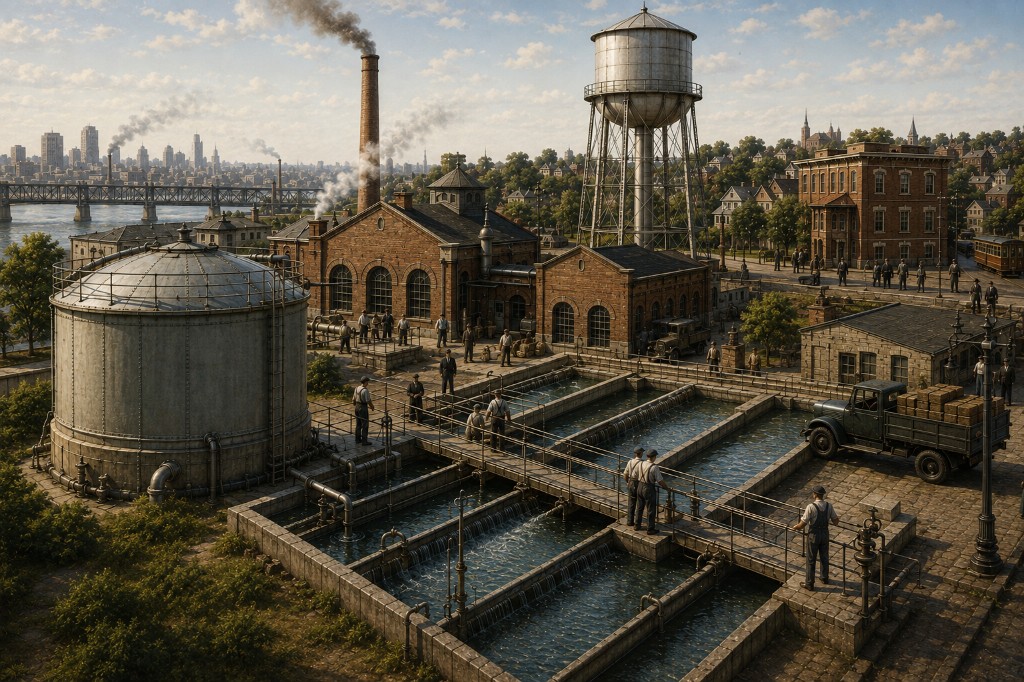
The 20th century: clean water becomes public-health infrastructure
At the beginning of the 20th century, the systematic treatment and disinfection of public water supplies began to be introduced on a mass scale.
In the United States, Jersey City began routinely disinfecting public water in 1908, after which the practice spread rapidly.
The result was dramatic.
The incidence of diseases such as typhoid fell sharply as treatment, disinfection, sewerage and sanitary practices expanded. The CDC identifies the treatment and disinfection of drinking water as one of the great public-health achievements of the 20th century.
For the first time, clean drinking water ceased to be the privilege of a good natural source.
It began to be an engineered, guaranteed product.
How water is purified today
Modern drinking-water treatment is not one technology, but a sequence of processes chosen according to the composition and quality of the source water.
Typical stages can include:
- coagulation and flocculation, in which fine particles clump together;
- sedimentation, in which heavier formations separate;
- filtration, which removes various impurities;
- disinfection, aimed at pathogenic microorganisms.
Activated carbon, ultrafiltration, ozone, UV treatment and various membrane technologies are also used.
One of the best known is reverse osmosis – Reverse Osmosis (RO).
In it, water passes through a membrane that allows a wide range of dissolved substances and contaminants to be removed. Reverse osmosis has an important application in treating saline and recycled water.
The historical change is enormous.
For millennia the human question was:
“Where is there good water?”
Modern technology increasingly allows us to ask:
“How can we turn the water we have into water that is fit to use?”
But the water problem is not solved
Technological progress easily creates the impression that safe water is already universally available.
It is not.
According to the latest global estimates by WHO and UNICEF, 2.1 billion people in 2024 still lack access to safely managed drinking water. Of them, 106 million continue to use untreated surface water sources directly.
WHO also notes that unsafe water, sanitation and hygiene continue to be linked to at least 1.4 million preventable deaths a year.
This is important context.
In the 21st century the problem is no longer simply whether Earth has enough water.
The question is where it is, what condition it is in, how much treatment and transport cost, and how far water-supply systems can withstand demographic, infrastructural and climatic change.
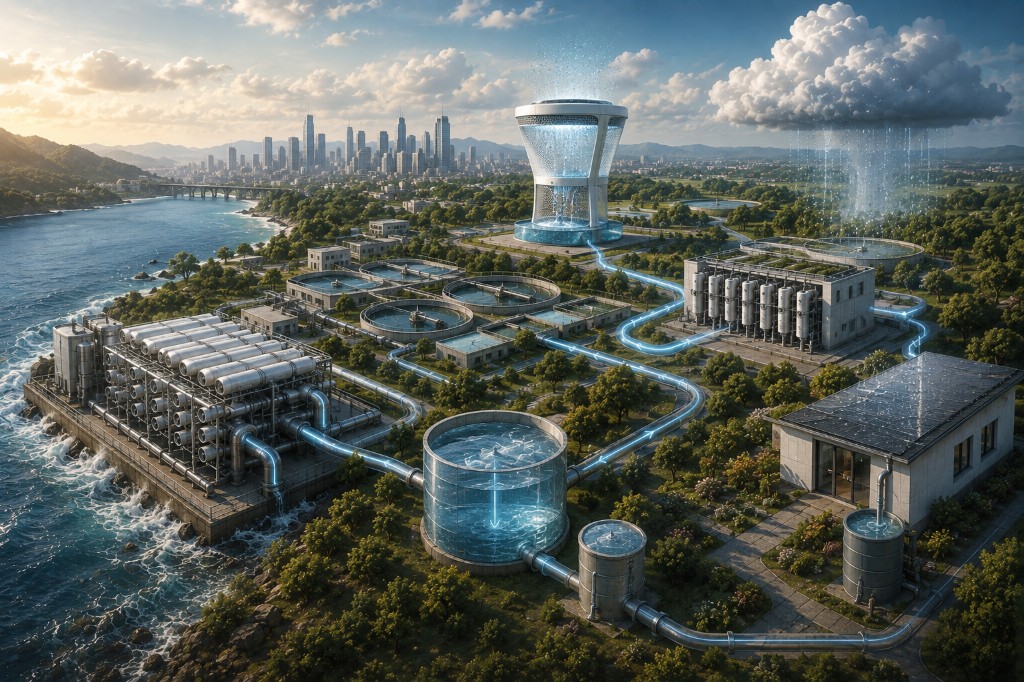
The new era: looking for water beyond the traditional source
Until very recently the logic of water supply looked practically unchanged:
water source → treatment infrastructure → transport → consumer.
Today this model is beginning to expand.
Desalination makes it possible to turn seawater into fresh water.
Modern systems allow an ever higher level of purification and reuse of wastewater.
Rainwater can be collected and managed locally.
And a relatively new category of technologies poses an even more interesting question:
can the water source be the air itself?
Water from air: a new idea with an ancient physical principle
The atmosphere contains water in the form of water vapour.
This is not an exotic phenomenon. We see it every day – in clouds, fog, dew and condensation on a cold surface.
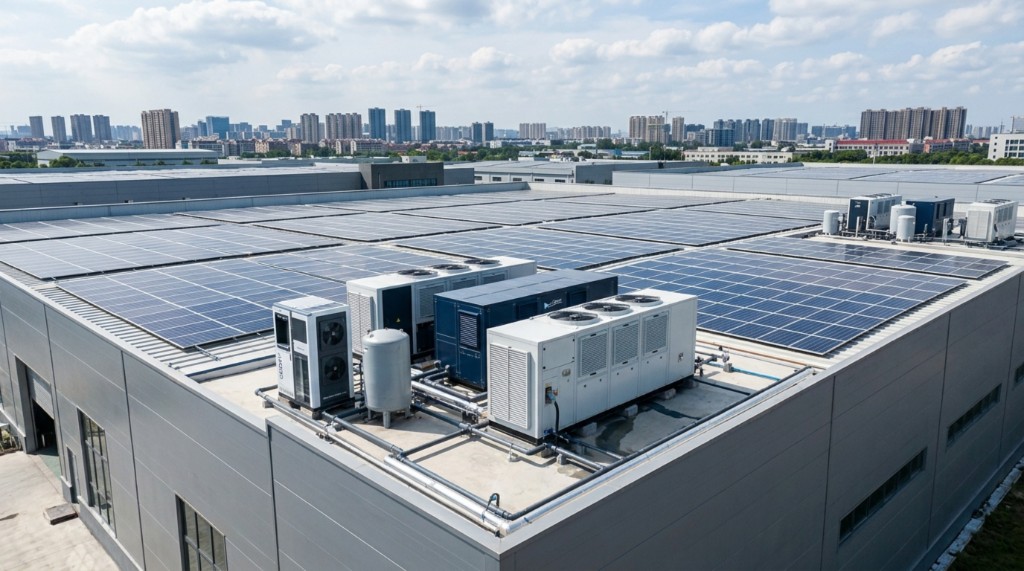
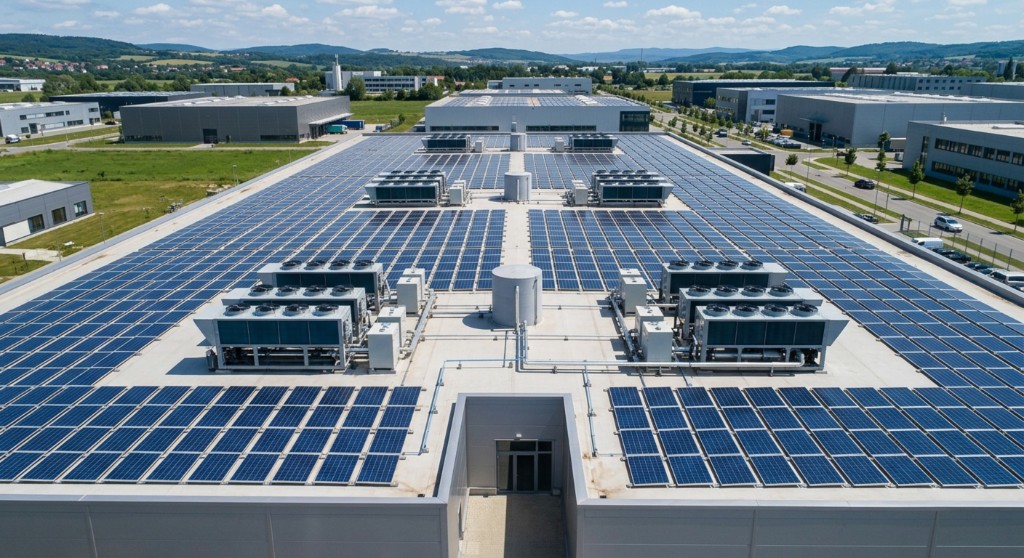
Atmospheric water generators, or Atmospheric Water Generators (AWG), use precisely the moisture present in the air as a potential water source.
In condensation-based technologies, the air is processed so that part of the water vapour it contains passes into the liquid phase. The water obtained then goes through a defined system of treatment, filtration and quality control according to the design of the specific equipment and its intended use.
At the physical level the principle is familiar.
What is new is the scale and the control.
Why water-from-air technology is interesting
The most important idea in generating water from air is not that it necessarily has to replace traditional water supply.
What is more interesting is that it changes the geography of water.
The traditional system centralizes the process: water comes from a specific source, is treated and is then transported.
Decentralized technologies make it possible for part of the water to be produced closer to the place of consumption.
That potentially opens new applications in hotels, offices, manufacturing plants, logistics centres, remote sites, public spaces and other environments.
But the technology also has clear physical limits.
The production of water from air depends to a significant degree on temperature, relative humidity, energy consumption, design and the efficiency of the system.
Atmospheric water generation is therefore not “water from nothing”.
It is a technology for using an existing, but for a long time practically unused, water resource – atmospheric moisture.
From the river to the atmosphere
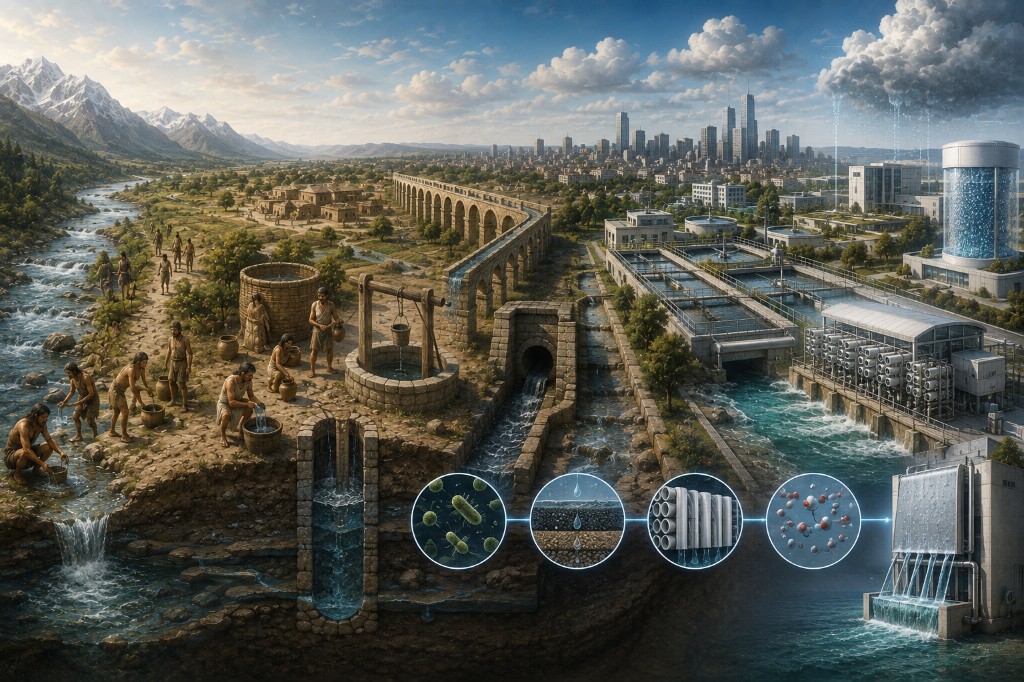
Looked at from a sufficient distance, the history of drinking water follows a remarkably clear line.
First we followed the water.
Then we began to store it.
After that we built canals and aqueducts to bring it to us.
We dug wells to reach the invisible reserves under the ground.
We learned to separate wastewater.
We discovered microorganisms.
We began to filter and disinfect.
We created membranes capable of turning salt water into fresh water.
And now we are gradually learning to use the water that is above us and around us as well.
This is not simply a history of technologies.
It is a history of the gradual freeing of human society from an ancient constraint:
the need for suitable water already to exist exactly where we need it.
How civilization’s oldest question is changing
For prehistoric people the question was:
“Where is there water?”
For ancient cities:
“How do we bring the water to the people?”
For the industrial age:
“How do we make the water safe?”
For the 20th century:
“How do we provide safe drinking water on a vast scale?”
And the 21st century adds new questions:
How do we use water more efficiently?
How do we reduce dependence on limited or vulnerable water sources?
How do we produce water closer to the place where it will be used?
And what sources that until recently we neglected can become part of the water supply of the future?
One of them has always been around us.
The air.
Want advice on the right model?
Request a quote