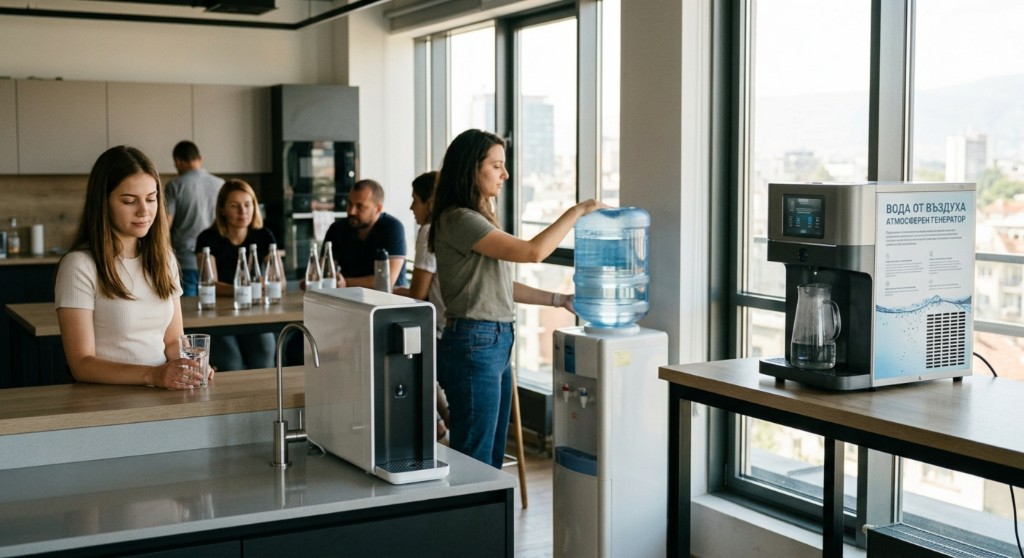
Choosing water for a home or office usually comes down to price, taste and convenience. We buy bottles, order dispenser jugs or install a filter — and rarely stop to notice that behind these seemingly similar options sit completely different supply models.
In recent years another option has been added: atmospheric water generation. It is not simply another filtration method, but a different approach: instead of treating water we already have, it uses moisture in the air as the primary source.
That is why the four options are better compared not only by what ends up in the glass, but by where the water comes from, how it reaches us, and what its availability depends on.
Bottled water — the familiar option with invisible logistics
The main advantage of bottled water is predictability. We buy a product with a defined origin, composition and producer. It is convenient at home, for meetings, for travel and practically anywhere without a fixed water point.
The downside is that every litre must be physically transported.
One litre of water weighs about one kilogram. If an office uses an average of 100 litres of bottled water per working day, that is about 25 tonnes of water a year over 250 working days — water that must be bottled, delivered to the building and stored. Packaging is added on top.
The European Commission notes that EU rules on single-use plastics target products most often found as litter on European beaches, including bottles and caps. That does not mean bottled water has no place. It means its convenience has a material and logistical footprint.
The dispenser — fewer small bottles, but delivery remains
With large-jug dispensers, the model is more efficient in terms of packaging count. One container serves many glasses and can often be reused.
The principle, however, does not change much. Water is still produced or bottled elsewhere, transported to the customer, stored and periodically refilled.
For a small office this can be a perfectly reasonable solution. With higher consumption, though, not only water price matters — so do delivery frequency, storage space and the logistics of empty and full bottles.
Filtration — when you already have a reliable source
Filter systems solve a different problem. They do not deliver or produce water; they improve certain characteristics of water that already reaches the building.
Depending on the system, that may include mechanical filters, activated carbon, reverse-osmosis membranes, UV treatment or a combination of technologies.
This matters because filtration is sometimes the most logical choice. If a building has reliable supply and the water meets regulatory requirements, there is little sense in treating the technology as a problem that must necessarily be replaced.
In the EU, drinking water is regulated by Directive (EU) 2020/2184, which sets quality standards and introduces a risk-based approach to water safety.
Filtration’s weak point is different: it remains dependent on the available water source. If supply is interrupted, the filter has nothing to treat.
Water from air — a different model
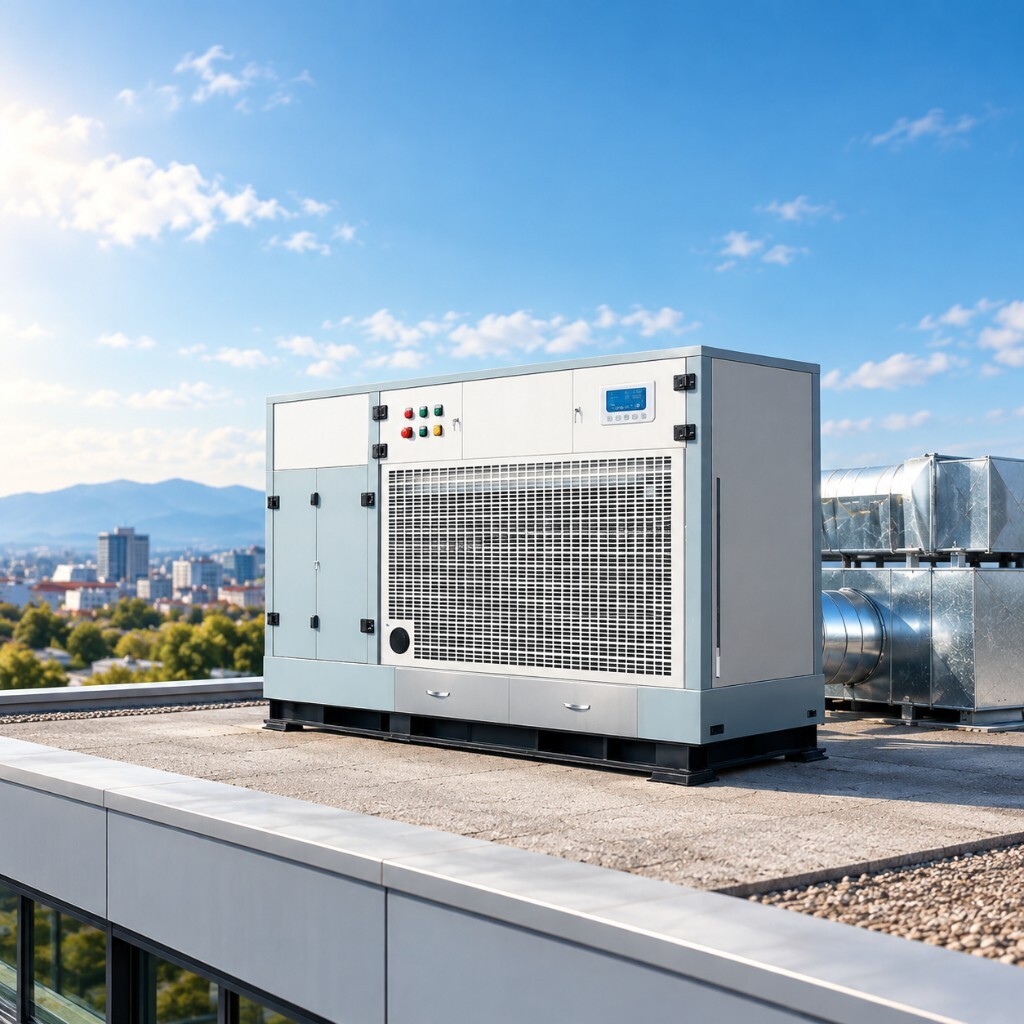
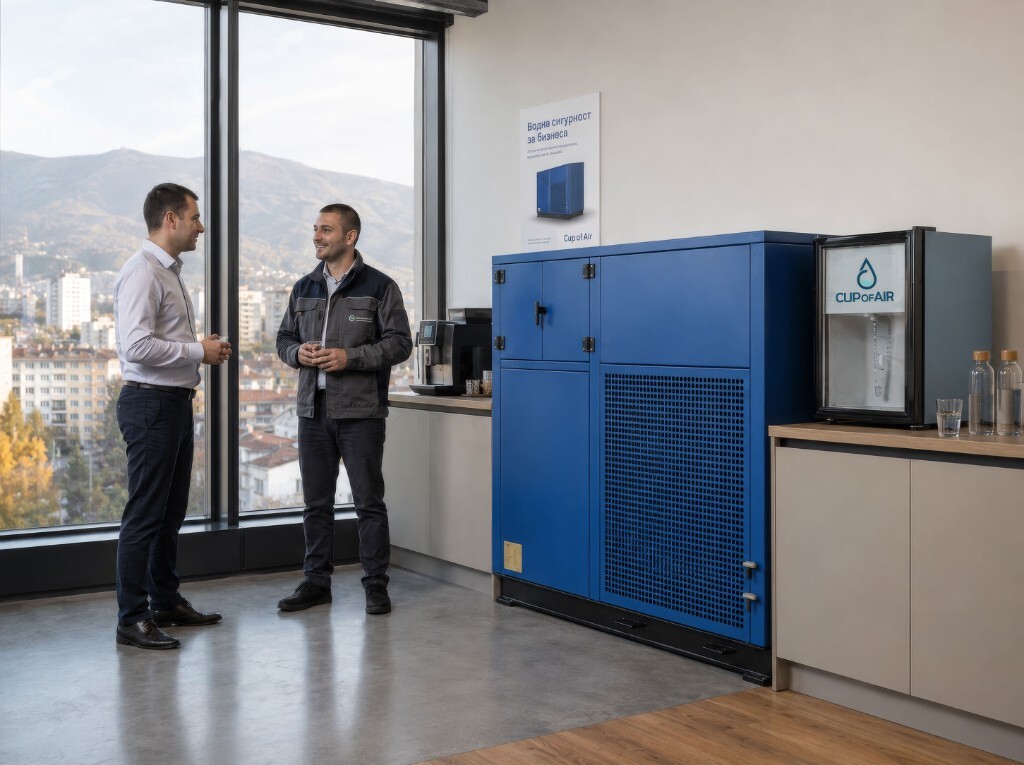
With atmospheric water generators, the primary source is moisture naturally present in the air. In condensation systems, air is cooled to a temperature where water vapour condenses. The resulting water then goes through treatment and disinfection according to the specific system.
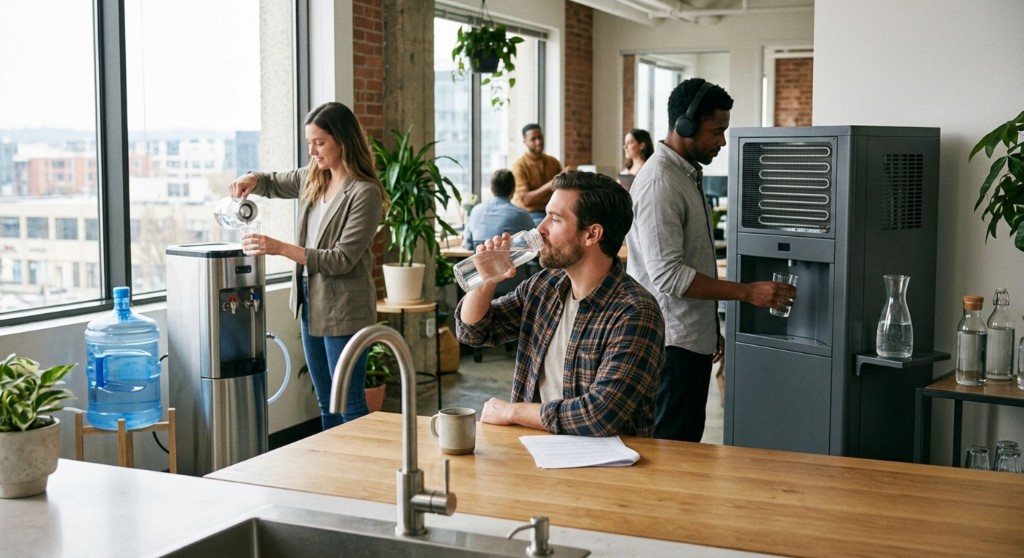
Here there is an important difference: finished water does not need to be transported to the point of use, and an incoming piped source is not required for generation itself.
That does not mean “free water from air”. The machine uses electricity, and output and energy efficiency depend on temperature and relative humidity. Warmer, more humid air usually creates more favourable conditions for condensation systems.
That fact belongs in every serious discussion of the technology. AWG is not a universal replacement for mains water — nor does it need to be.
Its value lies elsewhere: in the ability to generate water locally, independent of delivered finished water.
Which option makes sense?
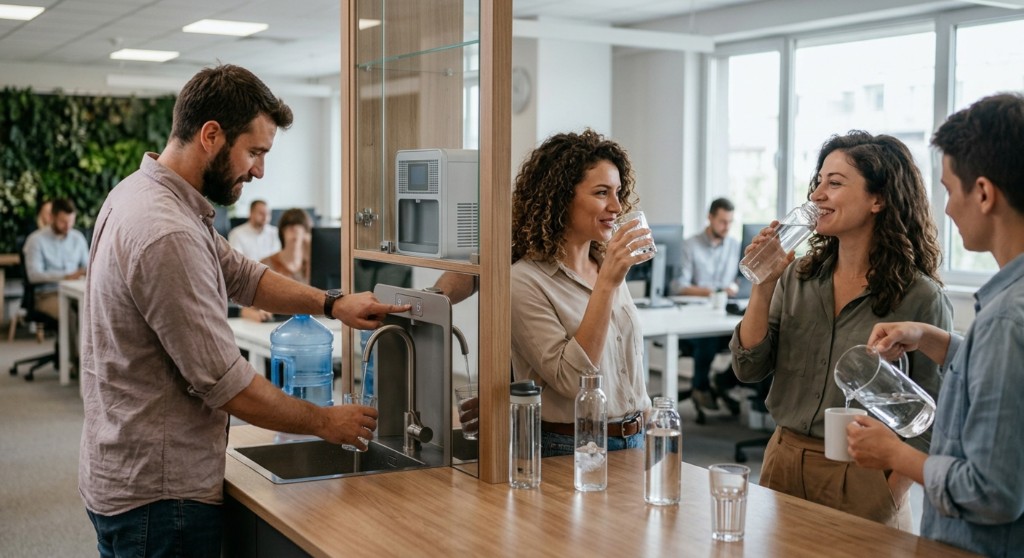
If you have good mains water and want to improve taste or certain characteristics, filtration may be the simplest solution. If consumption is small and irregular, bottled water is extremely convenient. A dispenser fits where you want a central water point without installing your own system.
Atmospheric generation becomes interesting for a different task: when you want to reduce dependence on deliveries or a specific water source, and conditions allow efficient local production.
That is why the argument over “which water is best” is not especially useful.
The more interesting question is what water supply will look like in ten or twenty years. Until now, the main model was water extracted in one place and delivered through infrastructure or transport. Today another option is being added: producing part of the water where it is actually used.
And that is already a meaningful change.
Need help choosing the right option for your site?
Request a quote