Until recently, a sustainable building mainly meant one thing: consuming less.
Better insulation. More efficient heating and cooling. Lower electricity and water use.
Today the idea is shifting. The more interesting question is no longer only “How do we reduce consumption?”, but:
“How much of the resources it needs can the building itself produce?”
This is not just an architectural trend. Buildings are the largest single energy consumer in Europe and account for about 40% of energy consumption in the EU. European policy is already moving toward a zero-emission building stock, and the new European standard expects all new buildings to be zero-emission from 2030.
The next generation of buildings can go one step further — from efficient consumers to active producers and managers of resources.
Energy has already shown it is possible
Photovoltaic systems changed the role of the roof. Space that once had a mainly structural function can now generate electricity at the point of use.
And this is no longer a niche solution. According to the International Energy Agency, distributed solar systems — on residential, commercial and industrial sites — are expected to account for around 42% of the global expansion of solar PV capacity through 2030.
A building can already be both a consumer and a producer of energy.
So why not apply the same logic to water?
From water consumption to water-resource management
The traditional model is linear: water arrives at the building, is used, and leaves the system.
But solutions for reusing suitably treated water streams are gaining importance. The European Commission points to water reuse as a way to reduce pressure on water resources and strengthen resilience in times of scarcity.
That introduces a different philosophy: not every drop should have only one life cycle.
There is another opportunity too — instead of only saving and reusing available water, to create an additional local source.
The air also holds a water resource
The atmosphere around us constantly holds water as vapour.
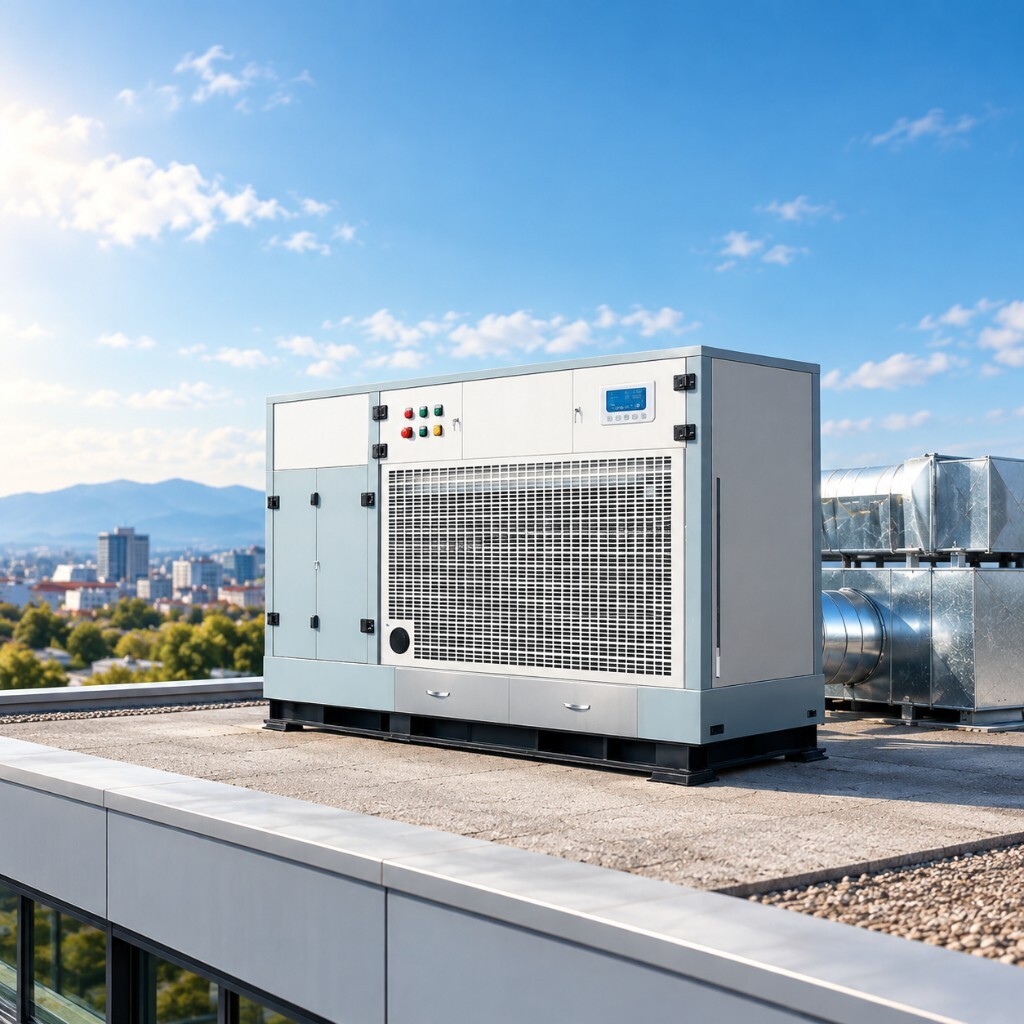
Atmospheric water generators use that humidity, condense it and turn it into water that then goes through treatment and filtration.
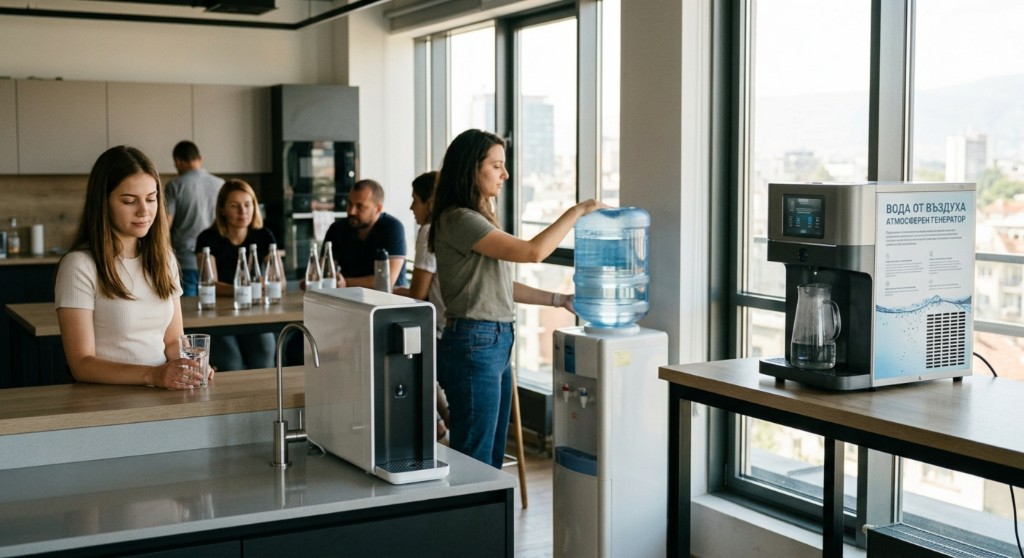
This opens an interesting possibility for buildings: generating part of the water right where it will be used.
An important distinction is needed. Atmospheric generation should not be presented as a universal replacement for mains water infrastructure. Output and energy efficiency depend on temperature, relative humidity, the specific technology and operating conditions.
But precisely as an additional decentralised source, the technology becomes especially interesting.
When one technology starts powering another
Imagine a building with a photovoltaic system that produces part of the electricity it needs.
Some of that energy can power an atmospheric water-generation system.
In the same building, certain water streams can be treated and reused for suitable non-potable applications.
We end up with three connected principles:
- Sun → electricity
- Air → water
- Used water → treatment → new use
And that is where the bigger idea appears.
It is not about one machine, one solar panel or one water-recycling system.
It is about a new resource architecture for the building.
Autonomy does not necessarily mean “off-grid”
A building does not have to be fully independent to be more sustainable.
The more realistic question is: How much of its dependency can it reduce?
If a building produces part of its electricity, generates part of the water it needs, reuses certain water streams and manages consumption intelligently, it already has a more diverse resource model.
That can be especially relevant for hotels and resorts, office and business complexes, manufacturing sites, logistics hubs and remote facilities — particularly when sustainability, resource security and ESG goals are part of the business strategy.
The International Energy Agency already describes the future role of buildings in this direction — not as passive consumers, but as active participants in the energy system that can produce, store and manage resources at the same time.
From “smart building” to resource-smart building
For a long time, “smart building” meant automation.
The next stage may be the resource-smart building — a building that understands where its resources come from, how much it uses, what it can reuse and what it can produce itself.
This is exactly where we see the place of atmospheric water generation.
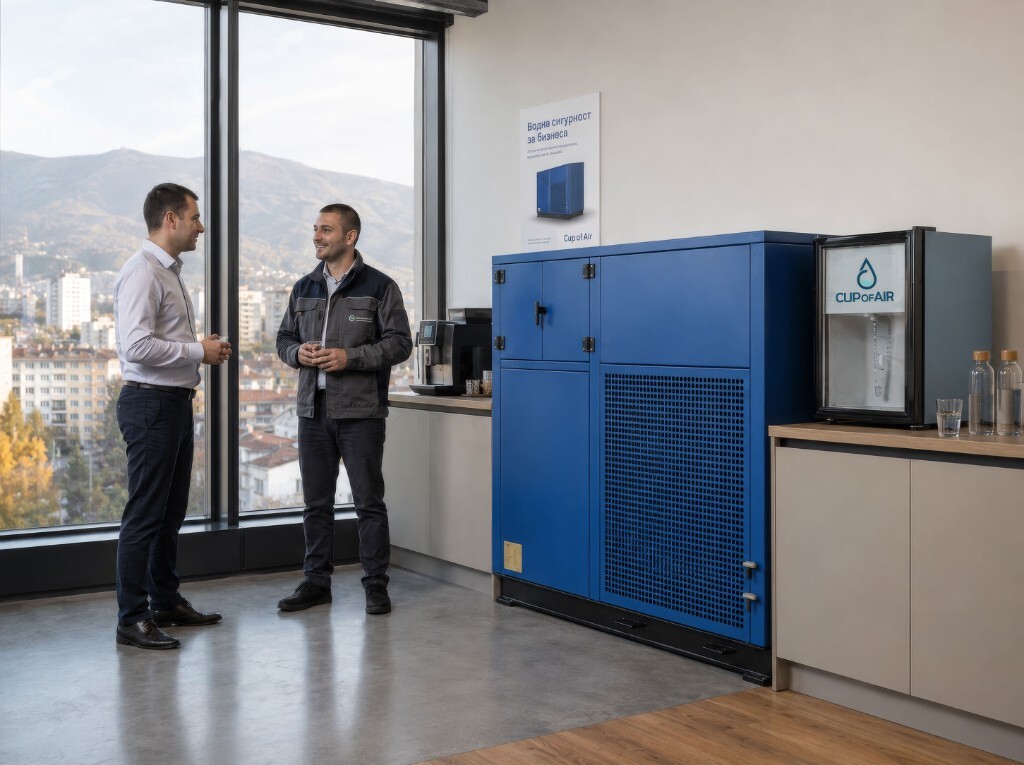
At Cup of Air, we see the technology not simply as an alternative way to obtain water, but as part of a wider shift toward more decentralised and more autonomous buildings.
Because the building of the future will not only be designed to use less.
It will be designed to produce more of the resources it needs.